
The Hands That Kept India’s Art Alive
### A story of Indian artisans, forgotten traditions, and the beauty we must not let disappear
There are some things in India that cannot be taught from a book.
They are learnt by watching.
A child sitting beside a grandmother, quietly observing how her fingers shape a piece of clay. A young boy watching his father heat lac until it becomes soft enough to mould. A family sitting together late into the evening, painting tiny flowers onto a piece of pottery with a brush so fine that even the slightest mistake can change the entire design.
This is how many of India’s crafts have travelled through time.
Not through museums alone.
Not through textbooks.
But through *hands.*
For generations, Indian artisans have carried knowledge that is often older than the buildings around them. In many families, a craft is not simply a profession. It is a legacy.
A skill learnt from a parent, perfected over years, and eventually passed on to another pair of hands.
And yet, strangely, some of the people who have protected these beautiful traditions for centuries remain almost invisible to the world.
## When a craft becomes a family legacy
Imagine a craftsman sitting at his workbench.
He may not have a large workshop. There may be no sophisticated machinery around him. Perhaps his tools have been used by his father and grandfather before him.
His hands, however, know exactly what to do.
He knows how much heat the lac needs.
He knows when clay has reached the right consistency.
He knows which colours will work together.
He knows how a traditional pattern should look even without drawing it first.
These things are difficult to explain.
They are *felt, practised and remembered.*
In several Indian craft traditions, skills have remained within communities and families for generations. The techniques may change slightly with time, but the soul of the craft remains.
That is what makes Indian handicrafts so special.
When you hold one in your hands, you are holding more than an object.
You are holding a little piece of someone’s inheritance.
—
## The glow of Lac Bangles
Take *lac bangles*, for example.
Bright, colourful and unmistakably Indian, lac bangles have been part of traditional adornment for generations. The craft involves heating and shaping lac, forming it carefully around the bangle and decorating it with colours, stones, mirrors or other embellishments depending on the regional style.
To someone seeing a finished set, they may simply look like beautiful bangles.
But to the artisan, there is much more behind them.
There is the knowledge of handling the material.
There is the patience of shaping it correctly.
There is the understanding of colour and ornamentation.
And there is years of practice hidden inside every smooth curve.
A single bangle does not tell you how many times the artisan’s hands have repeated the same movement to make it look effortless.
That is the beauty of traditional craftsmanship.
*Years of hard work often appear as simplicity.*
## Blue Pottery: Colour painted by hand
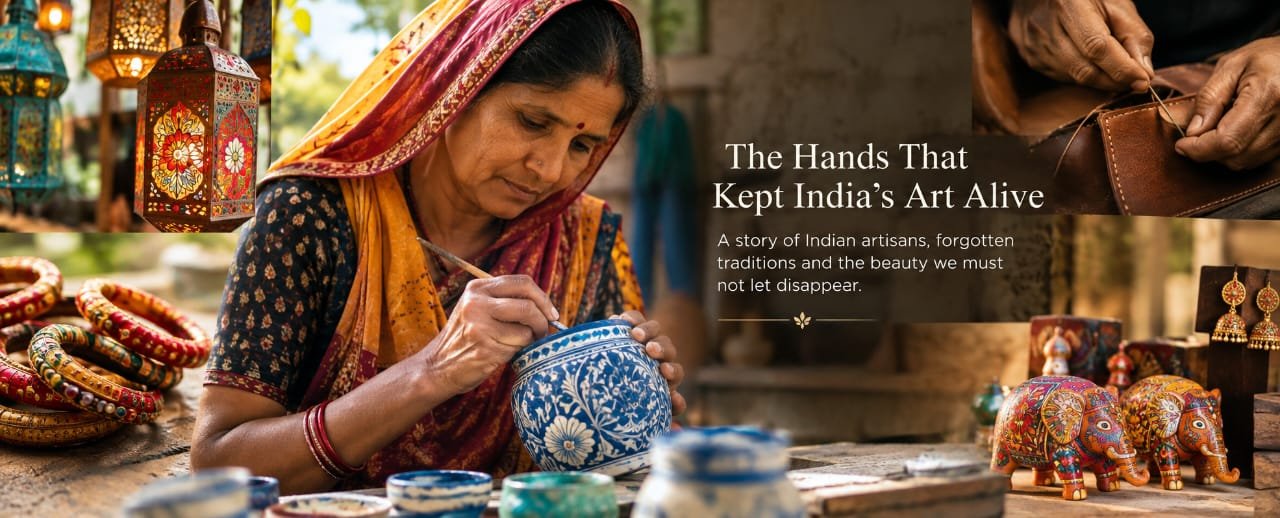
Then there is *Rajasthani Blue Pottery* — one of India’s most recognisable decorative arts.
Its distinctive blue and turquoise tones have become closely associated with Rajasthan. Yet behind the beauty of a finished piece lies an intricate process of preparing, shaping, firing and decorating.
The artisan’s brush becomes almost an extension of the hand.
Flowers, leaves, vines and traditional motifs slowly appear on the surface.
No two pieces feel quite the same because they are touched by human hands.
A tiny variation in a line or brushstroke is not a flaw.
It is a signature.
It tells us that a person sat there and made it.
## Terracotta: When earth becomes art
Perhaps one of the oldest stories is the simplest one.
*Earth.*
Across different parts of India, artisans have worked with clay and terracotta for generations, turning ordinary earth into figurines, decorative objects, jewellery, lamps and countless other forms of art.
Think about that for a moment.
A material that begins beneath our feet can pass through an artisan’s hands and become something that someone treasures inside their home.
Terracotta jewellery carries that same magic.
It may not have the shine of precious metal.
It does not need to.
Its beauty lies in its texture, its handmade character and the traditional forms and motifs that artisans bring to life.
There is something deeply human about wearing something made from earth by another person’s hands.
## The crafts that survived , but the artisans who made them are still waiting
India is home to countless such traditions.
Some are celebrated widely. Others are known only within particular regions and communities.
And many have survived despite enormous challenges.
Mass production can create thousands of identical pieces in a fraction of the time. Machines can reproduce patterns quickly. Cheap imitations can travel across borders more easily than the original handmade work.
But a machine cannot inherit a craft from its grandmother.
A factory worker may reproduce a design, but it cannot carry the personal history of the artisan who has spent decades mastering it.
This is where we, as buyers, have a role.
Because traditions survive not only when artisans continue making them, but when *people continue valuing them.*
## Behind every handmade product is a person
We often ask:
*“How much does it cost?”*
Perhaps we should sometimes ask:
*“How long did it take to make?”*
How many hours were spent sitting at that workbench?
How many failed pieces came before the perfect one?
How many generations contributed to the knowledge behind it?
How many times did an artisan choose to continue making something by hand when an easier, faster method was available?
These questions change the way we look at handmade products.
A handmade bag is no longer simply a bag.
A saree is no longer simply fabric.
A piece of jewellery is no longer simply an accessory.
A handcrafted object becomes a connection between the maker and the person who chooses to take it home.
## The world needs to see India’s artisans
Indian craftsmanship deserves a place on the global stage.
Not because everything traditional must be preserved exactly as it was forever, but because these traditions represent *knowledge, creativity, identity and human skill* that cannot easily be recreated once lost.
There are talented artisans working quietly across India who may never have the opportunity to showcase their work internationally.
There are also young designers and craftsmen taking traditional techniques and giving them a new life — creating contemporary leather coats, bags, jewellery and lifestyle products while still drawing inspiration from India’s rich design heritage.
They deserve to be seen too.
*Tradition does not have to remain stuck in the past.*
It can walk into the future.
—
## Perhaps the simplest way to preserve an art is to use it
We can talk about heritage.
We can write about disappearing crafts.
We can photograph artisans and tell their stories.
But one of the most meaningful ways to support craftsmanship is remarkably simple:
*Buy it. Use it. Gift it. Wear it. Talk about it.*
When someone chooses a handmade bangle instead of a mass-produced imitation, an artisan gets an opportunity to continue.
When someone buys a handcrafted piece of pottery, that craft remains commercially relevant.
When someone chooses an Indian artisan-made gift for a friend across the world, the story travels with it.
And when a customer asks, *“Who made this?”*, the artisan is no longer invisible.
—
# At India at Clique, we believe every craft has a story
India at Clique was created with a simple thought:
*India has too many beautiful stories to remain unseen.*
We want to bring together Indian products that reflect the country’s craftsmanship, creativity and cultural diversity — from traditional jewellery and specialised sarees to handicrafts, leather products, handmade journals, gifts and distinctive creations by Indian artisans and emerging designers.
Our hope is not simply to sell products.
It is to help create a connection between *the hands that make and the people who appreciate.*
Because somewhere in India, there is an artisan still working with the same patience that generations before them had.
Perhaps their workshop is small.
Perhaps their name is not known around the world.
Perhaps they have never imagined that something made by their hands could travel across oceans.
But it can.
And perhaps that is where the story changes.
A craft that once belonged to one village can find a home thousands of kilometres away.
A young designer’s creation can reach someone who has never visited India.
A grandmother’s traditional technique can become part of another family’s story.
And an artisan who once worked quietly can finally be seen.
## So, the next time you choose something handmade…
Pause for a moment.
Look at the little imperfections.
The uneven brushstroke.
The tiny variation in shape.
The marks left by the hand.
Don’t look for perfection.
*Look for the person.*
Because behind India’s crafts are hands that have worked through heat, dust, long hours and uncertain markets.
Hands that learnt.
Hands that taught.
Hands that remembered.
And hands that refused to let a tradition disappear.
### Let us help those hands continue.
**Discover Indian craftsmanship.
Support Indian artisans.
Celebrate India’s living heritage.**
### Explore India at Clique
*Authentic Indian Products • Artisan Craftsmanship • Emerging Indian Designers • Worldwide Shipping*
Lorem ipsum dolor sit amet, consectetur adipiscing elit. Ut elit tellus, luctus nec ullamcorper mattis, pulvinar dapibus leo.